
The official website of Dr. Yousef Abu Awwad
Dr. Yousef Fouad Abu AwwadThe Clear Arabic Tongue: A New Method for Studying the Quranic Text
A Jordanian writer and researcher, born in Amman, Jordan, in 1984. He specializes in Arabic linguistic studies and the analysis of the Quranic text. He has devoted himself to studying the Quranic text linguistically across every level of linguistic analysis: phonetic, morphological, syntactic, stylistic and textual. He has written many articles in this field and produced many video episodes explaining Quranic concepts on the basis of their linguistic analysis.

Ask «Lisan»
The AI assistant for Dr. Yousef Abu Awwad's published work. Write your question about his ideas on the Holy Quran and the Arabic tongue, and «Lisan» will answer from them.
«Lisan» runs on paid AI services built on the most precise software. Each user may ask one question a day for free; you can ask more questions by supporting «Lisan».
Source of information: all of Dr. Yousef's visual, written and audio output. The answer is composed by AI, so it may differ from what Dr. Yousef meant.
Previous questions
What does prayer (salah) mean according to Dr. Yousef?October 17, 2026
Book a consultation with Dr. Yousef Abu Awwad
A private session; you choose its length and time.
Who is Dr. Yousef Abu Awwad?
Dr. Yousef Fouad Abu Awwad is a Jordanian writer and researcher specializing in Arabic linguistic studies and the analysis of the Quranic text.
Born
In Amman, Jordan, in 1984.
PhD
In Linguistic Studies / Arabic Language from the World Islamic Sciences and Education University (WISE), with a thesis titled «Contrastive Formal Shift in the Holy Quran».
years in teaching
He has worked as a teacher, lecturer and supervisor of Arabic in many educational institutions, and has taken part in a number of academic conferences and seminars as a researcher and discussant.
Books
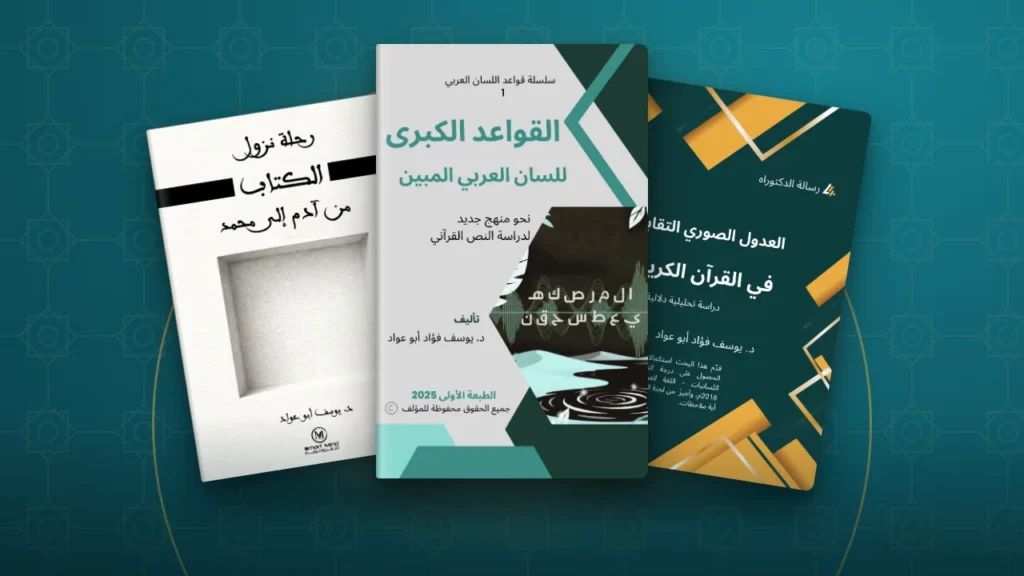
- The Major Rules of the Clear Arabic Tongue
- The Journey of the Book's Descent: From Adam to Muhammad ﷺ
- Contrastive Formal Shift in the Holy Quran
- A Critique of the Narrative of Reports Attributed to the Prophet Muhammad ﷺ
Dr. Yousef Abu Awwad's books, course, articles and lectures
This website brings together the works of Dr. Yousef Fouad Abu Awwad, the Jordanian researcher specializing in Arabic linguistic studies and the analysis of the Quranic text, including the book «The Major Rules of the Clear Arabic Tongue», the book «The Journey of the Book's Descent: From Adam to Muhammad ﷺ», and his doctoral thesis «Contrastive Formal Shift in the Holy Quran», along with the course «Explaining the Major Rules of the Clear Arabic Tongue», and links to his video lectures and published articles.
 01
Books
Dr. Yousef Abu Awwad's works on studying the Quranic text through the Clear Arabic Tongue, read in full on this website.
Browse the books → 02
Course: Explaining the Major Rules
A recorded course with video explanations of the content of the book «The Major Rules of the Clear Arabic Tongue».
Go to the course → 03
Video Lectures
The «Mafaheem» (Concepts) video episodes in order, watched on this website one episode after another.
Watch the lectures → 04
Articles in Al-Mujtama Magazine
His articles published in Al-Mujtama Magazine, numbered from the oldest to the newest, with the opening of each article and a link to read it.
Read the articles →The key ideas put forward by Dr. Yousef Abu Awwad
Eleven ideas that sum up his reading of the Wise Revelation through the Clear Arabic Tongue: each idea in its own words, then its details and evidence, with links for those who wish to read more in his articles and episodes.
-
1. The Method
The Holy Quran is a self-sufficient Book
It is studied by one single means, the Clear Arabic Tongue: analyzing its words, sentences and passages in this tongue, through contemplation (tadabbur) and internal ordering (tartil), without bringing in any outside text. Many verses of the Wise Revelation point to this means, and the Revelation itself calls it (study).
In detailIn the Arabic tongue, «dars» (study) is walking a path again and again until no bumps or landmarks remain on it. So studying the Book means going back and forth within the text itself, again and again, until no haze remains and the meaning becomes very clear. Contemplation means not taking a word and cutting it off from its context, but reaching the end of the verse and the end of the context, then returning once more; whenever you contemplate, you will find no contradiction.
﴿إنا أنزلناه قرآنا عربيا لعلكم تعقلون﴾ — “We have sent it down as an Arabic Quran, so that you may reason.” [Yusuf 12:2]
﴿ولكن كونوا ربانيين بما كنتم تعلمون الكتاب وبما كنتم تدرسون﴾ — “Rather, be devoted to the Lord, by what you have been teaching of the Book and by what you have been studying.” [Al Imran 3:79]
-
2. Faith and Islam
Faith (iman) and Islam are social concepts
Their linguistic analysis shows that their aim is to build a society in which people are safe from one another (yaslam) and grant one another safety (ya'man) through God. This means that peace and safety extend to every person who agrees to them, and to everything God has created. The basis of faith, as a social contract, rests on awareness of God as Lord of the worlds and the Maker of laws, so this peace and safety do not stop at any creed, race, color or law. Faith and Islam in this sense are conduct, rewarded with good in proportion to the benefit they bring.
In detailThe root (ʾ-m-n) denotes the opposite of fear in all its forms, and the four-letter verb (ʾāmana) refers to giving safety, granting it and spreading it in every direction. The object of faith in God is unlimited: it is granting safety to all human beings of every origin, land and belief, except those who commit aggression. Islam is refraining from harm, nothing more; faith is a higher stage, in which a society is built whose members exchange safety, so it builds, creates and sets things right on earth.
﴿الذين آمنوا ولم يلبسوا إيمانهم بظلم أولئك لهم الأمن وهم مهتدون﴾ — “Those who have believed and have not mixed their faith with injustice: theirs is safety, and they are rightly guided.” [Al-An'am 6:82]
﴿فمن يعمل مثقال ذرة خيرا يره﴾ — “Whoever does an atom's weight of good will see it.” [Az-Zalzalah 99:7]
-
3. Kufr, Shirk and Fusuq
Kufr, shirk and fusuq are forms of conduct
Their consequences are in proportion to the harm they cause others. The idea of tying them to beliefs and words that draw a dividing line between entering Islam and leaving it entirely is not a Quranic idea; all these concepts describe people's conduct, and they bring punishment and evil in proportion to their harm.
In detailKufr is when a person knows the truth, then turns it upside down, rejects it and covers it, as farmers bury seeds under the soil. Shirk was forbidden because it gives rise to methods and ideas that run against the laws of the universe, so collapse, division among people and fighting begin. For this reason, people may not be put on trial for words they say, even if they match in wording what the Quran says; doing good, doing wrong and punishment are built on conduct.
﴿ومن يعمل مثقال ذرة شرا يره﴾ — “And whoever does an atom's weight of evil will see it.” [Az-Zalzalah 99:8]
-
4. Creeds (Milal)
Judaism and Christianity are creeds of conduct
According to their analysis in the Wise Revelation, they are not tied to particular groups of people defined by civil-status cards. The Revelation has set out the traits attached to each of them, so what counts is having these traits and this conduct, not race or a name inherited from fathers and forefathers.
In detail(Alladhina hadu), «those who returned», are at root those who repented and settled after worshipping the calf, and (an-nasrani) is derived from (nasran), a pattern denoting being filled to the brim with a quality: it is a creed of conduct built on excess in «nasr» (support) to the point of extremism about persons. The traits common to both creeds rest on narcissism, claiming superiority over all other creatures, confining guidance, truth and Paradise to themselves, and taking intermediaries between themselves and God. Therefore the prohibition on taking them as allies is directed at whoever has these traits, not at a particular group of people.
﴿إن الذين آمنوا والذين هادوا والنصارى والصابئين من آمن بالله واليوم الآخر وعمل صالحا فلهم أجرهم عند ربهم ولا خوف عليهم ولا هم يحزنون﴾ — “Indeed, those who believed, those who returned (hadu), the Nasara and the Sabians: whoever believes in God and the Last Day and does good, they will have their reward with their Lord; no fear will be upon them, nor will they grieve.” [Al-Baqarah 2:62]
﴿وقالوا لن يدخل الجنة إلا من كان هودا أو نصارى تلك أمانيهم قل هاتوا برهانكم إن كنتم صادقين﴾ — “And they say: none will enter Paradise except one who is Hud or Nasara. That is their wishful thinking. Say: bring your proof, if you are truthful.” [Al-Baqarah 2:111]
-
5. Religion (Din)
Religion (din) is the law of recompense
It is one and the same for all the prophets and messengers. The Wise Revelation forbade in the strongest terms splitting over it, disputing in it and founding parties that claim it. This is achieved by understanding that religion is Islam, and Islam is refraining from harm: the minimum required of every human being to fulfil the duty of stewardship on earth, which is why disputing over it is not permitted. Nor is it right to widen the concept of religion to include anything beyond this; everything after the stage of Islam is ascent, elevation and raising the level of stewardship, and people's differences in it rest on mutual respect, while referring those differences to God's cosmic Book and His written Book in order to reach the highest degree of correctness at every stage of human life.
In detailAt its root, religion is how the aggressor, the oppressor and the wrongdoer are recompensed, not forms and rituals; it is the just system of recompense that guarantees the rights of all human beings without discrimination. That is why disputing over it and splitting because of it are not permitted: the law of recompense stops the oppressor in his tracks and returns to the oppressed his right, and these are not matters of dispute. If religion were redefined in this way, people would not differ over it, because it would rest on very clear human principles.
﴿إن الذين فرقوا دينهم وكانوا شيعا لست منهم في شيء إنما أمرهم إلى الله ثم ينبئهم بما كانوا يفعلون﴾ — “Those who have divided their religion and become sects: you have nothing to do with them. Their matter rests with God; then He will inform them of what they used to do.” [Al-An'am 6:159]
-
6. Quranic Narratives
They describe the stages of humanity's appearance on earth
Quranic narratives do not speak of a handful of peoples scattered here and there in parts of the Middle East. After his Quranic linguistic study, he finds that they describe the stages of humanity's appearance on earth up to its great spread across the continents, and this great spread happened only after the Book was sent down to Moses.
In detailThe Holy Quran divides the eras of humanity by the prophets, through features of civilization; it does not fix an exact date or place, and each stage records what existed in the stage before it, then adds growth and development to it. Moses, peace be upon him, is a central point of transition from the absence of the Book to the Book: a new beginning for humanity, the beginning of a human stability after which there was no great destruction like that which befell earlier peoples.
﴿ولقد آتينا موسى الكتاب من بعد ما أهلكنا القرون الأولى بصائر للناس وهدى ورحمة لعلهم يتذكرون﴾ — “And We gave Moses the Book, after We had destroyed the earlier generations, as insights for people, guidance and mercy, so that they may remember.” [Al-Qasas 28:43]
-
7. Fitrah (Innate Nature)
At their very beginning, people were one community upon the fitrah
They needed no messenger and no Book; messengers were sent and Books sent down only to return them to this first fitrah.
In detailThe guidance that humanity has been charged with following since the moment of its descent is the first fitrah, and people did not need prophets and Books to know it. They are social by nature, and in the conscience of each of them a restraint was planted that governs their relationship with their fellow human. The one community that is the origin of humanity is nothing but an enlarged image of the mother's system, in which its members flow smoothly toward their natural life; all the messages of the prophets revolved around returning to the original state humanity was in before the messengers were sent.
﴿كان الناس أمة واحدة فبعث الله النبيين مبشرين ومنذرين وأنزل معهم الكتاب بالحق ليحكم بين الناس فيما اختلفوا فيه﴾ — “People were one community; then God sent the prophets as bearers of good news and warners, and sent down with them the Book in truth, to judge between people in what they differed over.” [Al-Baqarah 2:213]
﴿وما كان الناس إلا أمة واحدة فاختلفوا ولولا كلمة سبقت من ربك لقضي بينهم فيما فيه يختلفون﴾ — “People were nothing but one community, then they differed. Had it not been for a word that preceded from your Lord, it would have been settled between them in what they differ over.” [Yunus 10:19]
-
8. The Prophetic Sunnah
The first practical application of the Holy Quran
The sayings and deeds of the Prophet Muhammad ﷺ that are most likely truly attributed to him represent the first practical application of the Holy Quran. They are the first practical image of the message and represent its finest and most sublime model, yet they are bound by the circumstances of the time and place of prophethood. We must therefore always measure these transmitted reports against the Wise Revelation, to come as close as we can to telling the sound from the unsound, and we must also benefit from them as fully as possible in ways that suit the circumstances of our own time and place and the realities of our age.
In detailThe Messenger ﷺ embodied, as a human being, the application and carrying out of God's message. The practical, real-world dimension is certainly what the message aims at, but it is not the message itself. What is sound among the reports attributed to him is the practical, applied image of the message itself, not a completion of the Book, nor an explanation or elaboration of it. Following him as a model means emulating the great idea: turning the theoretical message into practical reality in ways that suit our circumstances, our time, our place and our issues.
﴿أولئك الذين هدى الله فبهداهم اقتده﴾ — “Those are the ones whom God guided, so follow their guidance.” [Al-An'am 6:90]
﴿وإنك لعلى خلق عظيم﴾ — “And indeed, you are of a great moral character.” [Al-Qalam 68:4]
-
9. Ijtihad (Interpretive Effort)
Human study of the verses of the Book is open to error and correctness
and it changes as the age, its realities and people's knowledge change. The text remains the judge over all of it, and Islam, as granting peace and refraining from harm, remains an area where disagreement is not acceptable.
In detailA text whose authenticity is certain is not made subject to one that is speculative; rather, the speculative is studied critically and judged against the certain, and students are trained to extend their view in contemplating the text as far as the linguistic horizon reaches. The concept is one and the principle is one: they are ethical and behavioral standards, while their application differs with time and place, yet the essence is one. This is not disagreement; it is diversity. And the journey of research is an ongoing journey that never stops.
﴿أفلا يتدبرون القرآن ولو كان من عند غير الله لوجدوا فيه اختلافا كثيرا﴾ — “Do they not contemplate the Quran? Had it been from other than God, they would have found much contradiction in it.” [An-Nisa 4:82]
-
10. Peace
No fighting in religion except in defense of oneself and of rights
No one may, under any circumstances, be punished for a belief, nor may human differences be turned into conflict and fighting. The general rule that governs all of this is preventing corruption on earth and the shedding of blood.
In detailThe verb (qatilu, fight one another) necessarily implies mutual action: the passage speaks of people raising weapons to fight, which forces the believers to repel aggression, not because they want to fight. The jizyah is compensation for what is committed by one who violates what is sacred and rebels against public order; it has nothing to do with coercion into a belief or forcing a conviction. One of the self-evident fruits of the contract of faith is that the life of every believer is protected and inviolable, whatever their creed.
﴿لا إكراه في الدين قد تبين الرشد من الغي﴾ — “There is no compulsion in religion; right guidance has become distinct from error.” [Al-Baqarah 2:256]
﴿أفأنت تكره الناس حتى يكونوا مؤمنين﴾ — “Would you then compel people until they become believers?” [Yunus 10:99]
-
11. Worship
The purpose of creating humankind is the worship of God
Worship is achieved by keeping to God's laws and patterns (sunan) on which existence stands and by which the heavens and the earth are kept right. Rituals are only an aid the individual uses to reach this purpose, and the purpose of worship is taqwa: taking preventive measures against every evil and harm before it happens. Worship is walking the paths the Creator has drawn, and its aim is to reach the stage of protection by taking every measure that guards against the opposite.
In detailWorship is values, thought and conduct; it brings humanity back to its bond with the great laws of existence by which the order of the heavens and the earth has run, consistent and balanced. The messengers who addressed their peoples, «Worship God; you have no god other than Him», mentioned no rite and no ritual; rituals are only means of remembrance. Worship is nothing but life, all of life, without deviating from God's laws or upsetting the balance. This does not mean rejecting prayer, zakat, Hajj and Ramadan as they are known today; they are a means, not an end, and the call is to focus on their result and essence and to reject hair-splitting over their forms. The aim of worship is taqwa of God: taking every means of protection against going against God's laws and patterns, and against harm, injury and disaster.
﴿وما خلقت الجن والإنس إلا ليعبدون﴾ — “I did not create the jinn and humankind except to worship Me.” [Adh-Dhariyat 51:56]
﴿وإلى عاد أخاهم هودا قال يا قوم اعبدوا الله ما لكم من إله غيره أفلا تتقون﴾ — “And to Aad, their brother Hud. He said: O my people, worship God; you have no god other than Him. Will you not then be mindful (tattaqun)?” [Al-A'raf 7:65]